More than just rubbish
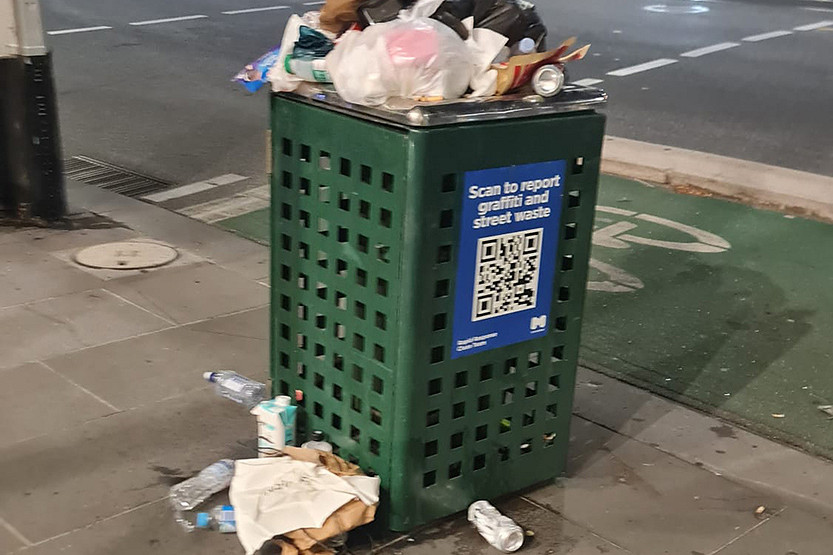

If you spend any time walking around Southbank, you’ve probably noticed it yourself. Overflowing rubbish bins have become an increasingly common sight across parts of our neighbourhood.
Whether it’s along Queensbridge St and Southbank Promenade, around City Rd, or on the corner of Power and Kavanagh streets, bins overflowing with takeaway containers, coffee cups and general litter have become a frustrating feature of the streetscape.
At first glance, this might seem like a relatively minor issue. After all, there are certainly bigger challenges facing Southbank. But public cleanliness plays an important role in how people experience a neighbourhood. Overflowing bins don’t just create litter; they influence perceptions of safety, amenity and civic pride.
What makes this issue particularly interesting is that it isn’t a new problem.
I recall attending the council meeting where the now-familiar “Big Belly” solar compacting bins were announced. The concept was impressive. By compacting waste and using technology to alert collection crews when bins were nearing capacity, the system promised cleaner streets, fewer collection trips and a smarter approach to waste management.
The announcement was accompanied by considerable enthusiasm. This was presented as a modern solution to an old urban problem.
The reality, however, was somewhat different. While the concept was innovative, the bins certainly didn’t quite stack up to expectations. Frequent maintenance issues meant they often struggled to deliver the reliability and efficiency that had originally been promised.
Yet many residents would reasonably ask whether the results have matched the expectations.
You may recall that I wrote about this issue several years ago in this column. Frustrated by the frequency of overflowing bins throughout Southbank, I spent considerable time documenting the problem and ultimately provided the City of Melbourne with more than 100 photographs showing overflowing bins at various locations, together with the dates and times they occurred.
Since then, I have remained aware of numerous residents who have continued to publicly raise similar concerns, whether through social media, direct correspondence with the council or conversations at community meetings. Indeed, it was recent feedback from residents that brought the issue back to my attention and prompted me to take another look.
The reality is that while the issue has received attention over the years, it has never truly gone away. If anything, many residents would argue it has become more noticeable as Southbank’s population, visitor numbers and pedestrian activity have continued to grow.
The good news is that the council appears to recognise the problem.
As part of the recently adopted 2026-27 Budget, additional investment has been allocated towards improving public waste infrastructure, alongside the introduction of a rapid-response service designed to respond more quickly when bins become full.
That is encouraging.
The real test, however, won’t be found in budget papers, council reports or media releases. It will be found on our streets.
Will residents notice fewer overflowing bins? Will hotspots such as Queensbridge St, Southbank Promenade and parts of City Rd remain cleaner throughout the day? Will the new response arrangements prove more effective than previous approaches?
These are the questions that matter.
As residents, we often hear about new initiatives, programs and technologies designed to improve city life. Sometimes they succeed brilliantly. Sometimes the outcomes are less obvious. The important thing is that we continue to assess results rather than simply celebrate intentions.
For now, this is very much a case of “watch this space”.
Southbank residents have been discussing this issue for years. The difference now is that the council has committed new resources to address it. Let’s hope that, this time, residents notice the change where it matters most – on the ground, and not just in the budget papers. •
Related Articles
If we can remove Pam the Bird, why can’t we remove this?
Melbourne has recently been talking about graffiti again following the appearance of the now infamous Pam the Bird on the Bolte Bridge.
Read More
How do we turn neighbours into a community?
Southbank has undergone an extraordinary transformation over the past two decades. What was once largely a commercial precinct has become one of Australia’s most densely populated residential communities. Every day, thousands of people call Southbank home—but increasingly, many of them are only here for a short time.
Read More
When a Southbank tree dies, the loss is bigger than it looks
A tree died outside my office recently.
Read More
MSO unveils ambitious 2027 season celebrating Australian talent and musical landmarks

Male sought over Southbank bin fires
 Download the Latest Edition