OC Act, rubbish and graffiti

Last month the state government opened a review into the Owners’ Corporation Act for public comment. As would have been expected, Southbank Residents’ Association (SRA) made a submission to this.
Considering we are also the convenors of the Southbank Owners’ Corporation Network, we were well placed for our opinions to be given some real consideration; well, so we are hoping.
While we raised a number of points around nuances of the Act, etc., we really wanted to make a point, and emphasised, that this was an opportunity for the Act to strengthen owners’ corporations (OC) with regard to lithium-ion batteries.
As is becoming all too apparent in the media, and our own experiences speaking with the local fire services, a week doesn’t go by without a report of a dwelling fire from a lithium-ion battery, usually when being charged, but also just as dangerous when not on charge. These are proving to be extremely dangerous and unpredictable items.
In a high-rise development, where nearly all our Southbank residents live, the risk is exacerbated as it is extremely difficult to stop the spread of the fire. Water alone has almost no effect on a lithium-ion battery fire, and they can explode with no warning. These are very dangerous items, yet now becoming ever more abundant in our homes.
We have asked the Act to consider this risk and use this as an opportunity to empower OCs to make and implement rules to assist them with managing the risk. At present it is extremely difficult and time consuming for most buildings to make changes to their rules. Therefore, we have asked the government to act in place of the need for buildings to make special rules for a problem, which is community-wide, covering tens of thousands of residences.
Let’s see if they agree and see the same urgency and opportunity we have identified.
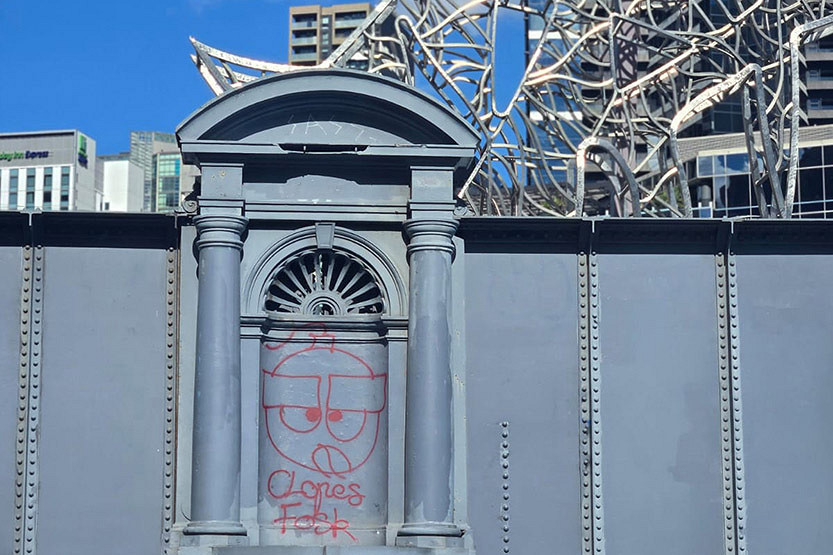
Last month I made a presentation to the City of Melbourne with more than 50 photographs of graffiti on the Sandridge Bridge pedestrian crossing and environs. I was disgusted with the amount of graffiti in this high traffic tourist space.
I specifically asked the council to include areas, such as Sandridge Bridge and other graffiti hotspots in regular checks instead of relying on the public to report the graffiti. They should take a proactive approach to this instead of being reactive.
I highlighted that I was gobsmacked that I can report graffiti on a particular wall, which will be cleaned, but the very adjoining wall, also with graffiti, is missed. It would have been obvious to the street cleaners when they attended. I asked if I literally need to photograph and report every single piece of graffiti and not rely on the initiative of the cleaning team to just clean it themselves. I suspect the contract only pays the contractor for what is reported and cleaned, and they don’t have the licence to search out graffiti themselves.
I also questioned if it was really that difficult to match the paint of the underlying surface. Sometimes the cover-up job is worse than the graffiti. The paintshop at Bunnings can do a better job at matching the paint than these so-called professionals cleaning our graffiti. I am still waiting for an official response from the council’s general manager of infrastructure and amenity (apparently this is his remit).
In that same council meeting they tried to spruik bins that have been sourced, which have sensors inside them to alert when they are getting full. I reminded them that about four or so years ago I was in that same forum where they were spruiking these new “big belly” bins and they too have sensors, which have proven to be useless.
I often see these rubbish bins overflowing. So much for the sensors that were paid for with this new technology – I think the council was conned on their benefits. Has the council forgotten that it had already purchased sensor bins all those years ago? •
Related Articles
When a Southbank tree dies, the loss is bigger than it looks
A tree died outside my office recently.
Read More
Temporary forever, or is Southbank simply unplanned?
In Southbank, we are no strangers to plans.
Read More
The Red Stairs: nearly a decade of debate
Few structures in Southbank generate as much discussion as the Red Stairs at Queensbridge Square.
Read More
“Federation Square of the South”: council backs tower but pushes harder for Queensbridge Square

STH BNK site heads to market in major blow for Beulah’s stalled Southbank supertower
 Download the Latest Edition