Packed meeting lays bare community hopes for Defence sites as council backs school and open space vision
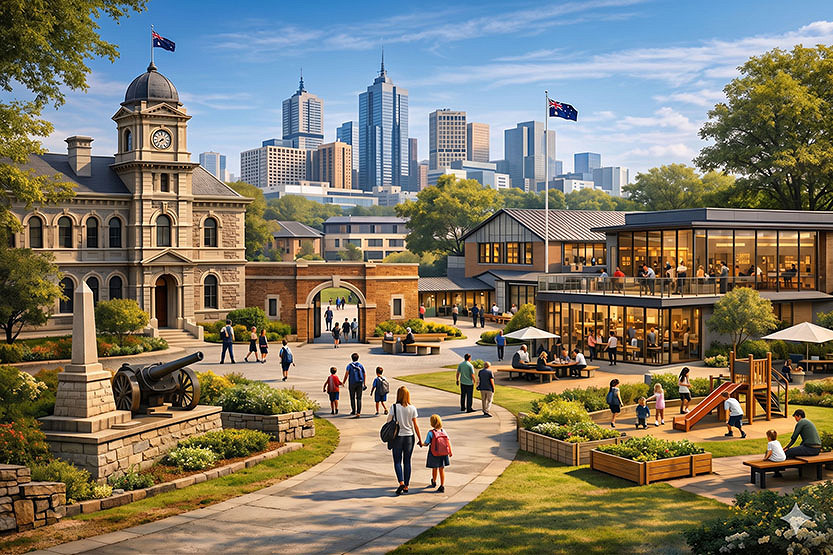

A standing-room-only community meeting at Yarra’s Edge on April 28 has laid bare the scale of public interest in the future of Melbourne’s surplus Defence sites, especially Victoria Barracks in Southbank, as the City of Melbourne moves to formally back a school, open space and heritage-led vision for the landmark precinct.
Hosted by the Commonwealth Department of Defence at the Array Tower community space on Lorimer St, the session drew around 130 people, cramming into a venue that itself served as a reminder of Southbank’s chronic shortage of community facilities. The fact that such a major meeting, that largely centred around the future of Victoria Barracks was not held in Southbank, despite the enormous local interest, was not lost on many in attendance.
The event came as part of the federal government’s consultation process following the Defence Estate Audit, which identified Victoria Barracks Melbourne, the adjoining Repatriation Clinic at 310 St Kilda Rd, and the Carlton Training Depot at 65 Grattan St among sites earmarked for divestment.
Leading the meeting was Assistant Minister for Defence Peter Khalil, who sought to calm fears and correct what he described as misinformation around the proposed sales. He said no decisions had yet been made about who any sites would be sold to, or what their ultimate future use would be, and stressed that heritage protections remained central to the process.
On Victoria Barracks in particular, Khalil made clear that the Commonwealth was not looking to erase the site’s history.
“At Victoria Barracks Melbourne, one of the oldest bases and sites, the war rooms, the Cabinet rooms where John Curtin and the War Cabinet met, and General MacArthur, to make all of those very decisive and historic decisions during World War II are there,” he said. “And they’re there and kept in pristine shape. No-one sees them.”
He said the reform process should not only protect those spaces, but open them up.
I want to see it opened up to the Australian public to see our military history, our nation’s history, he said, adding that the inaccessible condition of many Defence museums and heritage spaces was a problem in itself. He pointed to Point Cook’s RAAF Museum as an example of the kind of public access that should be better supported.
The message from Mr Khalil was that “everything was on the table”, including social and affordable housing and community-focused reuse proposals. Importantly for Southbank, he acknowledged that the idea of a school at Victoria Barracks had already been raised with him. While he gave little away about any likely outcomes, that was one of the more encouraging signs to emerge from the meeting.
The assistant minister also addressed Australian National Veterans’ Arts Museum (ANVAM) deputy chair Mark Johnston about the long-running proposal for the former Repatriation Clinic at 310 St Kilda Rd to become a veteran arts and wellbeing hub. Mr Khalil said the site, while requiring major investment, would go through the same consultation and disposal process as the others, and said he was open to further discussions and a site visit.
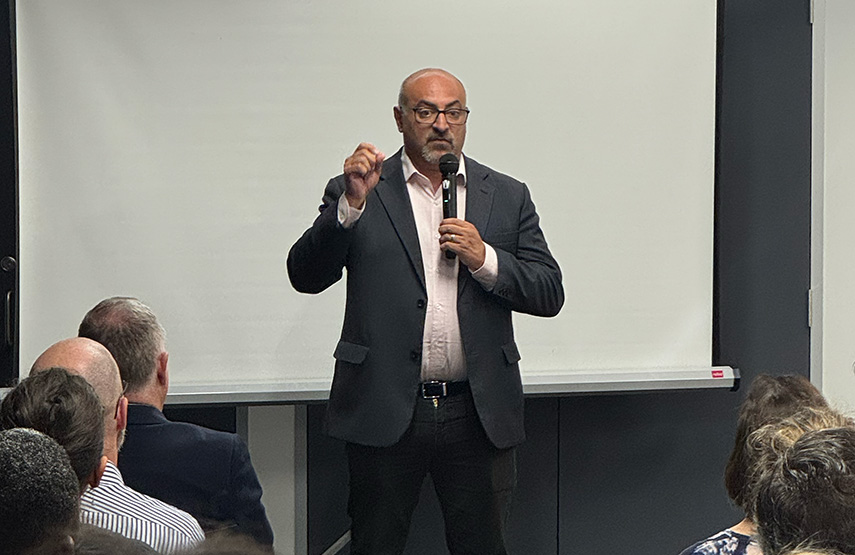
Still, for all the value of the meeting as a genuine engagement exercise, there was also a sense that the community learned relatively little that was concrete about what comes next. Mr Khalil repeatedly stressed that the process would take time, with Defence first handling transition, heritage planning and consultation before sites are formally handed to the Department of Finance for disposal. For large and complex sites like Victoria Barracks, that points to a process likely to stretch over years rather than months.
Smaller sites may move more quickly. The Carlton Training Depot, for example, is only 0.26 hectares and the City of Melbourne sees it as better suited to affordable housing and community infrastructure such as early years facilities. Once divested, it is expected to fall under the City’s heritage controls and a discretionary four-storey height framework.
The City’s position on all of this was clarified a week later, when the Future Melbourne Committee on May 5 unanimously endorsed a report and submission setting out the council’s preferred future uses for the Southbank and Carlton sites. The submission argues that Victoria Barracks presents “significant long-term potential” because of its strategic location, heritage significance and size, and says it is well placed to deliver community facilities, especially education, as well as public open space and adaptive reuse of heritage buildings.
Management’s priorities for the site, in order, are public open space, education such as a Prep to Year 12 campus, arts and cultural spaces, affordable housing, and public access to the site and heritage collections. For the Carlton Training Depot, the priorities are education uses such as early years facilities, and affordable housing.
The council’s indicative master plan for Victoria Barracks, shown in the committee papers, sketches out a possible future with large areas of new public open space, education and housing opportunities, and adaptive reuse of the significant heritage buildings for education, arts and cultural uses. The diagram on page 18 of the report sets out those zones visually, while page 17 summarises the current infrastructure gaps in Southbank, including deficits in early years facilities, playgrounds, arts and performance spaces, maternal and child health services and bookable community spaces.
Presenting the report, director of city strategy Jo Cannington told councillors the City was only at the “start of our thinking” but stressed that the site represented “a really once-in-a-generation lifetime opportunity to really optimise a major civic, cultural and open space asset” for Southbank and the broader city. She noted the site’s proximity to Anzac Station and said its accessibility made it suitable for a wide range of community-serving uses, including a possible school campus.
Lord Mayor Nick Reece described the 5.7-hectare barracks as “a huge bit of dirt” in one of the country’s fastest-growing neighbourhoods and said the City needed to get both the sale process and the planning right “for the next century and beyond”. He strongly backed new neighbourhood-scale open space and a Prep to Year 12 education facility, while also arguing that the site’s heritage, including the war rooms, should be opened up and celebrated.
Cr Davydd Griffiths called it more than a generational opportunity, saying it was the kind of moment that came around only once in “a city’s lifetime”.
Southbank3006 president David Hamilton, in both his submission and his presentation to the council, strongly supported management’s direction, calling Victoria Barracks “the last significant land parcel in Southbank” capable of delivering a K-12 school, open space, community facilities, arts uses and affordable housing while preserving heritage. He said the site was the suburb’s last real chance to correct decades of missing community infrastructure.
So where does this leave things?
The answer is somewhere between promise and patience. The Defence community meeting showed there is real appetite for these sites to deliver public value, particularly in Southbank. The council has now put a clear marker down in favour of a school, open space and heritage-led reuse. But the federal process remains in its early stages, and the biggest questions, especially around Victoria Barracks, are still years away from resolution.
What is already clear, however, is that the community is watching closely, and that governments at all levels will now be under pressure to ensure this once-in-a-generation land transition delivers more than just a sale. •
Caption: An AI-generated render of how Victoria Barracks could look as an education hub. Image: Southbank3006.
Related Articles
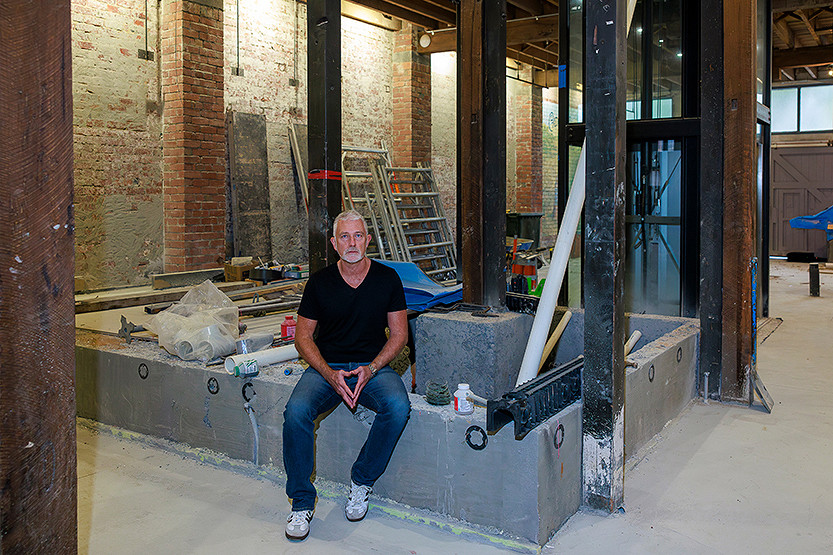
South Melbourne bathhouse on brink as heritage delays threaten $5m project
A $5 million bathhouse development in South Melbourne is on the brink of collapse, with its owner warning that ongoing heritage permit delays have left the project’s future hanging by a thread.
Read More
Strata reforms criticised as “tinkering around the edges”
Long-awaited reforms to Victoria’s owners’ corporation laws have been criticised by strata advocates as lacking the structural change needed to fix major problems in the state’s growing apartment sector.
Read More
Cladding program puts apartment fire safety in spotlight
Victoria’s combustible cladding rectification program has prompted fresh scrutiny of fire safety systems in apartment buildings, with a new survey identifying gaps in documentation, maintenance records and owner understanding.
Read More
Strata reforms criticised as “tinkering around the edges”

Soho reopens after arson attack with focus on future
 Download the Latest Edition