Public jab points to deeper Town Hall tensions
A public social media jibe by City of Melbourne (CoM) councillor Owen Guest has exposed fresh questions about unity, attendance and council-related travel at Town Hall, as the current council approaches the halfway point of its term.
The comment came in response to a Council Watch Victoria Inc Facebook post criticising the Australian Local Government Association’s (ALGA) National General Assembly in Canberra, which was attended by Deputy Lord Mayor Roshena Campbell, Cr Mark Scott and Cr Andrew Rowse in late June.
“Gold. Not sure but I might be the only non-junket traveller at CoM,” Cr Guest wrote.
On one level, the remark was a throwaway line on a public Facebook post. But for a sitting councillor to so casually ridicule colleagues over officially approved council travel says something about both Cr Guest’s combative style and the current dynamics inside the councillor group.

Cr Owen Guest's comment on a Council Watch Victoria Inc. Facebook post in June.
The Canberra conference had been approved by the council earlier this year at an estimated cost of $3600 per participant, with Cr Campbell, Cr Rowse and Cr Scott representing the City of Melbourne.
Lord Mayor Nick Reece had originally been endorsed to attend the ALGA conference but travelled to Singapore in mid-June 2026 to attend the World Cities Summit. Immediately following, he travelled to the UK to participate in London Climate Action Week. Cr Campbell attended the ALGA event in his place.
Council-related travel has become a recurring theme during the first half of the term, with approved trips and reports covering Canberra, Chengdu, Sydney, North Asia, Queensland, Shanghai, India, Brazil, Japan, Singapore, USA and London.
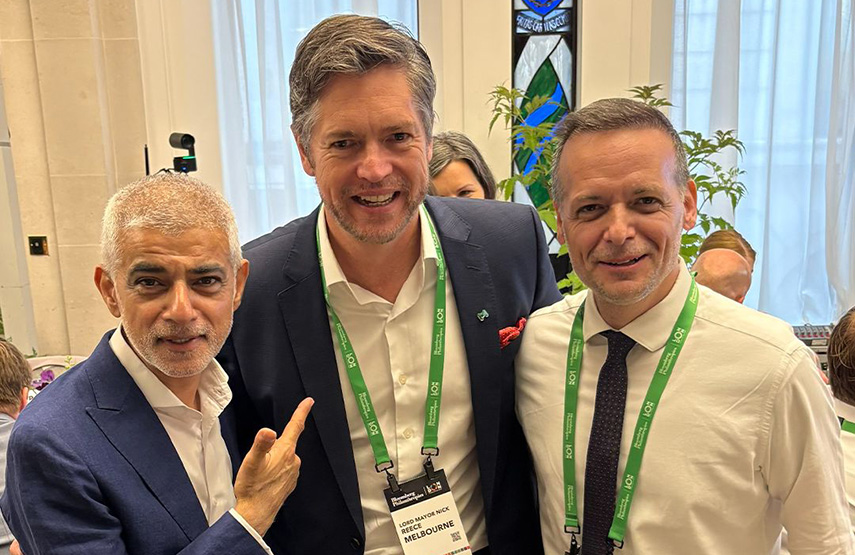
Lord Mayor Nick Reece with the Mayors of London Sadiq Khan (left) and Athens Haris Doukas (right) during his recent trip to the London Climate Action Week.
Supporters of such travel argue that it is part of Melbourne’s role as a capital city: building government relationships, attracting investment, advocating for funding and participating in national and international policy forums.
But the frequency of travel-related motions, together with unexplained absences, personal travel, remote attendance and public commentary about “junkets”, has sharpened scrutiny of councillors’ time away from Town Hall and the communities they were elected to represent.
At the time Cr Guest posted his Facebook comment in late June, four councillors were on council-related trips, and a further three – Cr Guest, Cr Philip Le Liu and Cr Gladys Liu – were all overseas on personal travel.
An analysis of 49 council and Future Melbourne Committee meetings between November 2024 and June 2026 shows generally strong attendance overall, but some clear outliers.
Cr Dr Olivia Ball and Cr Davydd Griffiths were recorded as present at every meeting reviewed. Cr Reece, Cr Liu, Cr Rowse and Cr Scott each missed one. Deputy Lord Mayor Roshena Campbell missed two.
Cr Le Liu recorded the lowest attendance, present at 41 of 49 meetings, with eight apologies. Cr Guest, Cr Rafael Camillo and Cr Kevin Louey were each absent four times.
The reasons for most apologies were not recorded in the minutes, making it difficult to distinguish between personal or sick leave, work commitments, council business or travel. Cr Le Liu’s attendance record has attracted attention, particularly after he departed during the May 12 budget submissions hearing, where the meeting was left with a thin quorum.
Cr Louey has also been a frequent remote attendee, joining 13 meetings by Zoom, more than any other councillor. He was also absent from the May 12 hearing and is understood to have recently been on a personal trip to Europe.
Southbank News understands that councillors who do attend the 5.30pm Tuesday meetings via Zoom have been absent from the council briefings held during the day in the lead-up, which provide crucial information and context.
Cr Guest, meanwhile, is understood to be on a six-week personal trip to the United States. He joined the June 30 council meeting via Zoom but has also recorded absences at other points this term.
His attendance is not the most irregular, but his voting record is by far the most unusual.
Across the 49 meetings reviewed, Cr Guest abstained from voting 30 times – more than double compared to any other councillor. Cr Le Liu and Cr Gladys Liu each abstained 12 times, while Cr Griffiths abstained 11 times.
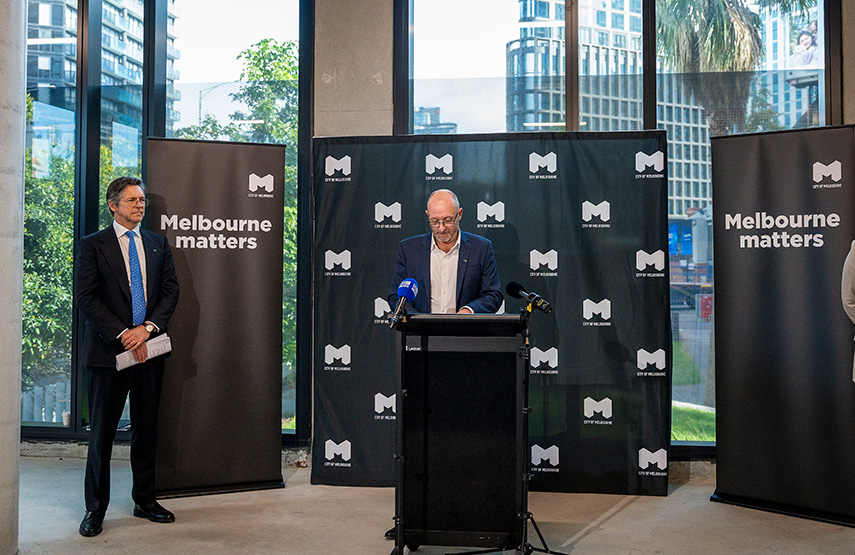
Cr Owen Guest with Lord Mayor Nick Reece announcing this year's draft budget. Photo: Huda Shehzad.
Some of Cr Guest’s abstentions have been on procedural or travel-related items, consistent with his criticism of council trips. But others have gone to core council business, including the 2026–27 Budget, despite his role as finance, governance and risk portfolio head.
He abstained on the Hawke Street Greening Project, amid concerns about parking impacts, and has repeatedly argued the council should focus more tightly on “roads, rates and rubbish” rather than broader advocacy or symbolic motions. He also abstained from cohealth community health centre closures, the council’s new heritage strategy, Fishermans Bend placenaming and the M2050 plan.
That approach has made Cr Guest a distinctive voice at Town Hall, but it also raises a fair question: at what point does repeated abstention move from protest to non-participation?
Councillors are elected to debate, scrutinise and ultimately make decisions. Abstention can be a legitimate tool when a councillor believes a motion is flawed, premature or compromised. But when used repeatedly, it risks becoming a substitute for taking a clear position.
The broader issue is not Cr Guest alone. The current council has already shown signs of division across debates on heritage, Aboriginal recognition, nuclear disarmament, international advocacy, urban greening, the budget, community safety and councillor travel.
Some of that tension is healthy. A council chamber should not be a rubber stamp, and ideological differences can improve decision-making when handled constructively.
But public sniping between councillors, repeated abstentions and unexplained time away from formal meetings all contribute to a perception of a chamber struggling for cohesion.
Nearly halfway through the term, the City of Melbourne’s councillor group still has time to reset the tone. Robust debate is part of democracy. So too is scrutiny of travel, spending and priorities.
But councillors also carry a responsibility to model the seriousness of the institution they serve. Publicly mocking colleagues may win applause from critics of local government, but it does little to build the trust, discipline and collegiality needed to govern the capital city well. •
Related Articles

Council to retire Big Belly bins as new “smart” fleet rolls out
The City of Melbourne will begin replacing its ageing Big Belly bins with 500 new smart compacting bins from August 15, following renewed criticism over overflowing rubbish across the CBD and Southbank.
Read More
Graffiti delays expose gaps between council and state agencies
The City of Melbourne has acknowledged that graffiti on key city assets can remain in place for months while it continues trying to negotiate faster and more consistent removal arrangements with state authorities.
Read More
City of Melbourne seeks seat at table on native title claim
The City of Melbourne has voted to join proceedings in the Federal Court relating to a native title claim over metropolitan Melbourne and surrounding areas.
Read More
Sale of Hanover House signals likely end for Beulah’s STH BNK vision

Farewell Southbank News: more than a newspaper
 Download the Latest Edition